
Oops! Wait... Wow!
For more great ideas, become more accident-prone

It’s no coincidence that so many great discoveries came about by accident.
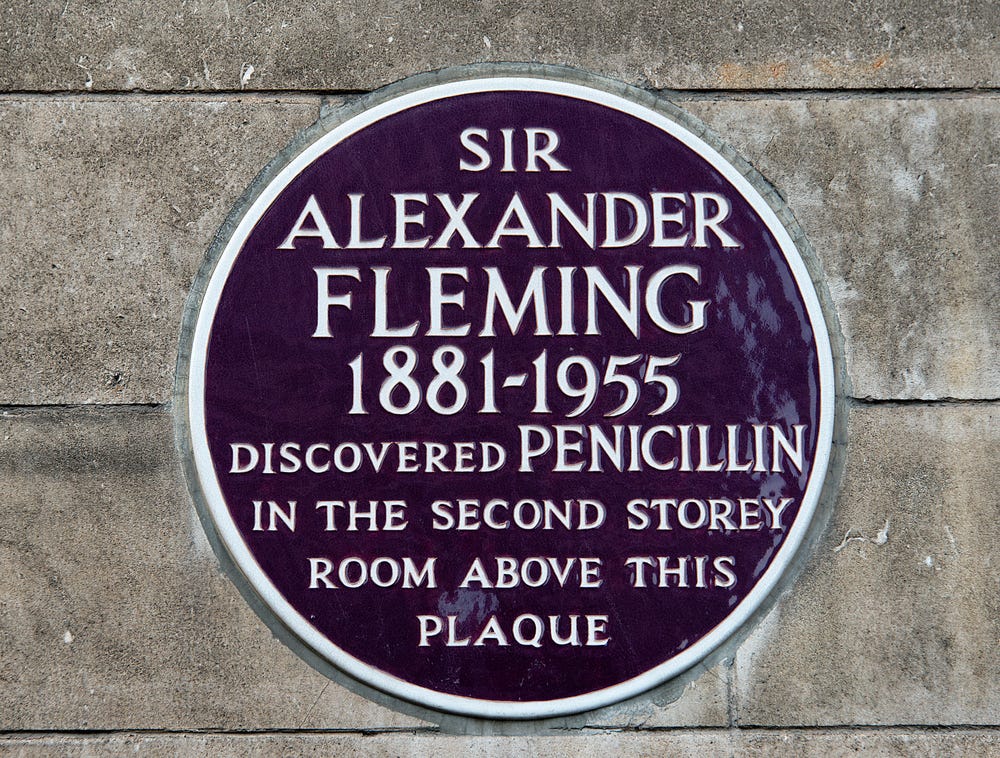
Alexander Fleming accidentally leaves a petri dish uncovered. Darn it! Mold contamination is starting to kill the bacteria. But wait… penicillin.
Spencer Silver wants to create a better adhesive. Aw, nuts! This one’s too weak to be useful. Hold on… it’s exactly right for a repositionable bookmark. Looks like I’ve invented the Post-It Note.
Roy Plunkett is trying to make a new refrigerant. The gas in one of his canisters hardens overnight into a slippery white solid. Wish stuff slid this easily off my cooking pans. Oops, I’ve invented Teflon!
Those clumsy Kellogg brothers try to come up with an easy-to-digest food. But they leave the wheat out too long. Darn, it’s stale and flaky. But wait… corn flakes!
And I love this one…
Ruth Wakefield runs out of baker’s chocolate to make chocolate cookies for her boarding house. Has an idea: Chops a chocolate bar into small pieces, thinking they will melt and blend in evenly. They don’t, and everyone falls in love with her newfangled chocolate-chip cookies.
And speaking of chocolate, I can’t resist one more…
Scientist Percy Spencer walks past a powerful vacuum tube that puts out electromagnetic radiation. He notices that the chocolate bar in his pocket has melted. Gets some popcorn kernels and puts them in front of it. They pop. Puts an egg down and literally winds up with egg on his face. Microwave cooking has arrived.
In spite of the rather clickbait-y subtitle to this article, the point is not to become more accident-prone.
Accidents will invariably happen.
The point is to be ready, curious, and open to discovery when they do. Like Fleming not throwing out the moldy petri dish, but wondering what was killing the bacteria.
Like Silver not just bemoaning the weak glue, but finding a use for it.
Like Spencer not just cursing his melted chocolate bar, but getting to the bottom of why it had unexpectedly melted.
The same thing happens in writing…
Some of the best headlines or wordings come from slips of the tongue, just joking around, mistakes — but only if you’ve prepared the ground for that seed to sprout and you’re open to serendipitous discovery.
One of my favorite newspaper headlines is from 1983 in the New York Post: "Headless Body in Topless Bar.” (Only in New York, right?) Vincent Musetto, the Post’s headline writer, didn’t take it seriously at first. Wrote it as a lark.
His editor rescued it from the trash can, and it went on to become one of the most quoted, admired, and imitated headlines in history.
The moral of the story? Try more things. Don’t be afraid to mess up. Joke around. Turn off your internal editor. What if you could say or do anything?
Don’t think of creativity, brainstorming, or writing as a direct route to a great idea. Because the best ideas come from stumbling around, bumping into things, and messing up. Sometimes even deliberately.
Maybe best of all: Being more accident-prone gives you a big advantage over AI, which is accident-averse, optimizes rather than meanders, and is far less likely to stumble onto something game-changing.
Some tips for facilitating serendipity:
Write fast and sloppily on purpose — Make typos, write half-finished thoughts, wrong words. Read it back. Sometimes what’s wrong is right.
Deliberately misread the writing you’re working on — Or your background material. It might take you somewhere interesting.
Listen for mistakes — If you pay attention, we’re constantly making big and small mistakes: a mispronunciation here, a wrong word there, a false start. Ask how that mistake could be turned into something interesting.
Encourage meandering — Joke around. Ignore red lines. Be absurd. Be wrong. Get lost. Go off on tangents and down rabbit holes (you just might find a cute bunny).
Write something down from memory — Unless you have a photographic memory, chances are it will be wrong in some way. Take a good look at it. Is it interesting? A different angle? A revelation?
I like it. When I'm stumped for what to write, I'll often just do a stream of consciousness brain dump. I start with a sentence and keep going, never knowing in advance what the next sentence will be or where it's taking me. After a bit, I think to myself - somewhere in here is an article. Now I just need to find it. And a few interesting phrases are scattered here and there as well.